Branching Out: Students Evolving Oakwood & The World
Oakwood’s Immersion is a two-week program allowing students to become fully engaged in rich, hands-on learning experiences. Designed to spark passion and curiosity, Immersion courses encourage students to explore new disciplines and take intellectual risks in a supportive environment. Through this work, students deepen their understanding of the subject matter while developing creativity, responsibility, and a lifelong commitment to inquiry, service, social justice, and action.
This year, Oakwood introduced Museums and Culture, an Immersion centered on the theory and practice of museum curation. Students explored the role museums play in communities and society while studying the elements that shape exhibitions, including floor plans, displays, historical materials, text, audiovisuals, and interactive experiences. They also examined questions of equity, ethics, accessibility, and power that influence museum practices today through visits to museums across Los Angeles.
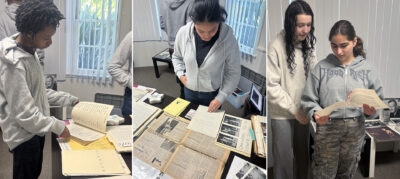
Students exploring Oakwood's archival materials.
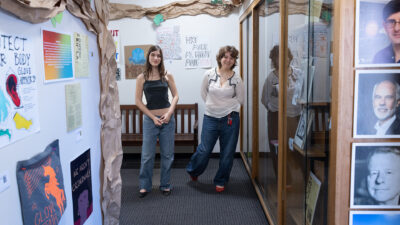
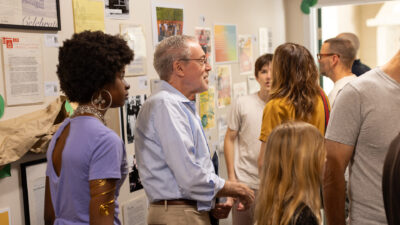
Beginning on day two, students turned their focus to piecing together the story of their own school. By engaging directly with decades of Oakwood’s records, yearbooks, photographs, and artifacts, students stepped into the role of curators to design and mount an exhibition on Oakwood’s history. In doing so, they discovered that archiving is not just about preservation; it is about perspective, and the power to reflect on how a community remembers itself. This culminated in the student-curated exhibition, Branching Out: Students Evolving Oakwood & the World, where visitors were invited to step back in time and explore how generations of Oakwood students have shaped both their school and the broader world through acts of community and expressions of individuality.
There were ways Oakwood was always radical, always sharing opinions, and also ways it wasn’t always the best it could be.
Lexi '29
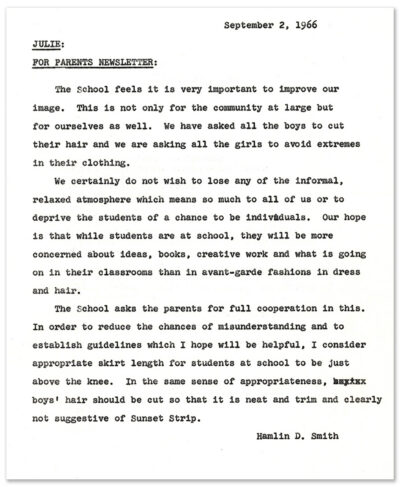
For Charlotte ‘29, one of the student curators, the archives reveal a version of Oakwood that feels both unfamiliar and strongly connected to the present. “The number one thing that struck me,” she says, “was a rule that ‘boys’ hair cannot be emulating Sunset Strip.’” The line is pulled from a 1966 letter from the school principal at the time asking students to focus on “ideas, literature, and learning” over “avant-garde fashion,” and greatly contradicts today’s culture of self-expression. “It makes me realize that nothing is just inherent,” Charlotte reflects. “Even in a place that encourages expression, that didn’t just exist; it came from change.”
As she and her classmates dug deeper, a pattern emerged: much of Oakwood’s history is a record of student action. From protests following a tragic drunk driving accident to campaigns for expanded programs and affinity spaces, the archives reveal a school continually reshaped by its students. “We started with a general idea about change,” Charlotte explains, “but then we saw it step by step, everything here is like a fingerprint from someone who came before us.” This realization is central to the exhibition, which highlights how student-led initiatives have left lasting marks on the school and the wider community.
A letter to parents from High School Principal Hamlin D. Smith. September 2, 1966
Lexi ‘29 found that the archives revealed many changes to Oakwood’s identity over time. “It shows a lot about Oakwood’s values and how they’ve changed with the people here,” she explains. “There were ways Oakwood was always radical, always sharing opinions, and also ways it wasn’t always the best it could be.” For Lexi, one of the most surprising discoveries was the extent of student activism, particularly Oakwood’s campaigns against drunk driving. “I didn’t know anything about that,” she says. “Seeing letters from figures like the Vice President and Nancy Reagan was really powerful.”
Lexi also noticed moments from the past, like stricter dress codes that seem different than Oakwood’s current policies. “I saw how there has always been a sentiment of caring about the students, but there was this idea that individuality through fashion was a distraction from education,” she says. “That’s so different from how we think now, especially with how much expression we have through art, murals, and everything around campus.” These contrasts help her see that the culture she experiences today was not always guaranteed.
Materials from Oakwood Students Against Drunk Driving.
This deeper understanding only strengthens her view of the school. “I’m really proud of how Oakwood has changed,” Lexi reflects. Learning about both institutional decisions and student-led efforts, like underground newspapers, grassroots organizing, and the creation of affinity groups, highlights a long tradition of students speaking up and shaping their environment. “It inspires me,” she adds, noting that even when a change wasn’t officially supported, students still found ways to make their voices heard.
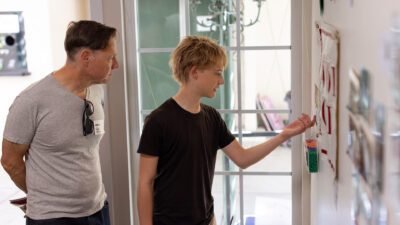
That sense of student voice is intentional, according to Oakwood social studies teacher Zoe Fox. As the school approaches its 75th year, she feels it is the right moment for this exhibition, while emphasizing that it is entirely student-driven. “No one has told me what the exhibit should be,” she says. “The students are choosing it, and that’s the point.” While she offers guidance, the vision belongs to the class, from the exhibition’s title to its central themes. “They did an amazing job and really championed their own school. It’s a testament to Oakwood,” she adds. “They were so invested in understanding Oakwood’s past.”
It makes me realize that nothing is just inherent. Even in a place that encourages expression, that didn’t just exist; it came from change.
Charlotte '29
Zoe also reflects on how the process clarifies something often described but hard to define. “There is an Oakwood feeling that people talked about when I began at the school, but no one could fully articulate it,” she says. “Through this process, I learned that the feeling is one of belonging.” Even as policies, traditions, and student life have evolved, she notes that this sense of connection has remained constant.
For Sofia ‘29, that sense of continuity stands out immediately in the archives. “Oakwood has kind of always had the same identity of a school that wants to make sure all their students have a place to belong and a place to share their voice and be as creative as possible,” she explains. “Oakwood has always pushed activism.” What stands out most to her, however, is how students expressed themselves across generations. “Seeing the old newspapers, especially the joke newspapers, was really cool,” she says. “Students have never been too scared to poke fun at administration.” To her, this reflected a broader culture. “Administration isn’t overbearing; they let students express themselves however they want.”
When asked whether working with the archives changed how she sees Oakwood today, Sofia is clear. “No,” she says. “I wouldn’t have expected the school in the 60s to be the same as it is now. I never thought it would be perfect forever. It’s just evolved.”
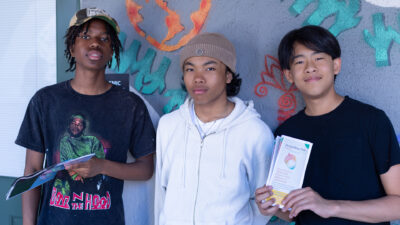
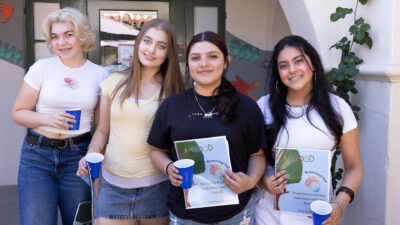
To accompany their exhibition, students created this catalog featuring photos, descriptions, exclusive alumni profiles, quotes, and a showcase of Oakwood spaces. archival materials, and teacher highlights.