Oakwood’s approach to AI encourages students not simply to use technology responsibly, but also to question it critically; to examine how AI systems are built and how they impact society and the planet as a whole. “We really pride ourselves on caring about others in our community and the world, and it was important that our AI policy reflected that and keeps kids questioning the tools they’re using.”
Beyond creating a framework, part of Oakwood’s philosophy is to help students develop confidence in their own voices and ideas. Especially with elementary campus students, Stacie emphasizes the importance of reminding children that their ideas matter. “I think a lot of folks turn to AI when they don’t feel secure in their own voice,” she says. “So they go to AI because it’s a fast way to do that.” Oakwood’s philosophy encourages students to view AI as just one tool among many that can support learning when used thoughtfully and critically.
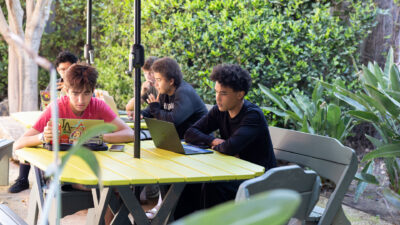
At the same time, she acknowledges that preparing students for a world increasingly shaped by AI is a complex and unprecedented challenge. For secondary campus students in particular, AI can function as a study tool and brainstorming partner. But Oakwood’s approach also insists that students understand that these tools have limitations and risks. Students are encouraged to question AI and think critically about issues like data privacy and surveillance.
Helping students understand why privacy matters and encouraging them to question how their data is collected and used has become another important part of the school’s work. “The kids live in a time where they don’t actually have an expectation of privacy,” she says. “That feels horrifying to older folks, but for students, it’s normal.” At the same time, she recognizes that these conversations will continue evolving alongside the world around them. “I think so much of that is going to be contingent on what’s happening in the world,” she says.
Ultimately, she hopes Oakwood students leave with both the ability to navigate AI tools and the confidence to think critically about them. She sees a successful policy as one in which students are asking difficult questions about the role AI should play in society. “I want them thinking beyond, ‘This can help me write an essay quickly,’” she says. “I want them asking: Why aren’t we regulating AI? Who benefits from this technology? What does it mean for our future?”
Another key goal is for students to see AI as a tool to support meaningful change: “In the future, I would like to see Oakwood kids being more vocal in ways they can use AI for good, through social justice movements. I think that would be something that would feel really Oakwood.”
Oakwood’s leaders and educators also recognize that Oakwood’s AI policy is a living document that will continue evolving with the technology itself. “It’s our responsibility to keep everyone updated,” she says. “Things can change month by month, year by year, based on the world and technologies.”
Yet even as the technology evolves, Oakwood remains rooted in the values that guide the school. “We really pride ourselves on caring about others in our community and the world,” Stacie says. At Oakwood, humanity comes first.