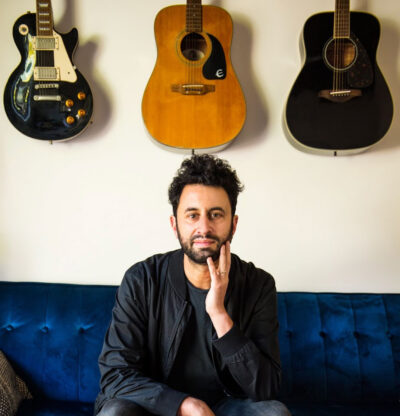
How did your time at Oakwood help shape who you are today, both personally and professionally?
The most important thing Oakwood provided for me was a space to experiment, screw up, and dream irrationally without fear of failure or judgment. While the notion that you can do anything and be anything is not necessarily true in real life (sorry, kids), it is an incredibly useful mentality to bring to adulthood, and in very real ways has led me to where I am today. At the tender age of 36, with a two-year-old daughter and a son on the way, I decided it would be a great idea to write my first musical, despite not really playing an instrument or having written a song since Middle School – a song for which I would not suggest anyone with functioning ears ever listen to. Seven years later, that musical sold out runs in L.A., Chicago, and Off-Broadway, and is heading to Washington D.C. Without Oakwood, I don’t think I would have that irrational belief in myself to try something totally new, which I had zero evidence I was capable of doing, as a dad in his mid-30’s.
When you graduated from Oakwood, did you have a clear sense of what you wanted to pursue academically or professionally?
Yes and no. I knew I wanted to be a writer of some sort, but I didn’t know in what capacity. After graduating from Oakwood and Columbia, I started in TV writing, then went to political speech writing, then journalism, then back to TV drama writing, then sketch comedy and Variety, then musical theater and songwriting. So, kinda?
Was there a class, activity, or teacher at Oakwood that had a lasting impact on you?
Strangely enough, the teacher who most impacted my eventual writing career was a Math teacher named Peter Wingerd. My senior year, Peter taught a course called “Philosophy of Math,” which was this super out-there and trippy exploration of mathematical concepts. I’ll be honest, I understood about half of what we talked about, but Peter was able to connect math to the arts and show us how creativity and experimentation influenced a universal subject that transcended simple numbers and equations. He also let us do whatever we wanted for our final projects, which led me to create two short films with my friends: One of those films was a delightful romp through space and time that Peter showed to future classes, and the other was a horrific and inappropriate mess that went straight into the trash heap where it belonged. Both experiences were instructive in different ways
Peter was also a frequent contributor to my illustrious Oakwood Arts Festival career, playing keyboards on an ill-advised but very cool rendition of Warren G’s “Regulate,” where I sang the Nate Dogg part. In a full circle moment, Warren G actually saw my musical “44” in L.A. Anyway, shout out to Peter Wingerd.
Have you had mentors, at Oakwood or beyond, who played a significant role in your journey?
See Wingerd, Peter above. But temperamentally, I’m not really a Mentor/Mentee type – I’m obstinate and opinionated and very much governed by my own instincts. Creatively, I work best peer-to-peer, with people who have complementary skillsets. I am also allergic to conventional wisdom and tend to tune out advice, criticism, and compliments. All this says far more about me psychologically than the concept of mentorship, but that’s just me being honest. Strangely enough, I love mentoring other people, and think I give very good advice. In other words, I’m a hypocrite. But a well-meaning hypocrite.
Can you share a brief overview of your career path and what ultimately inspired you to write 44: The Musical?
I described the outline of my writing career above – a circuitous route of various writing explorations that somehow led me into musical theater – but the primary source of inspiration for “44” was actually my brief foray into politics in 2008 on Obama’s first campaign. I worked as a field organizer in Las Vegas, while also doing some writing for the campaign on the side, and that experience became the foundation for the musical, which centers around Obama’s first term in office. So my writing and my political experience ultimately fused together.
What challenges did you face while bringing 44: The Musical to life?
First of all, I had no idea what I was doing. That’s not me being fake humble – I literally had no idea how to write music, score a musical, read music, play music, or write the book to a musical. Right before I began writing the musical in 2016, I found my way into a writing job on a variety show called “Maya & Marty” starring Maya Rudolph and Martin Short. They asked me in the job interview if I knew how to write music, because they needed a comedy writer who could bring that element to the show. I said sure. Then they said, “Great, can you send us something?” I said, “Sure. I just need a couple of days to ‘clean it up.’” Which was a lie. I had nothing.
But over the weekend, I wrote a song called “White House Love” for Maya Rudolph, plunked out a demo on piano, sent it to a buddy of mine to help me record it, and got the job. I moved to New York the day after I got married, and began working on “Maya & Marty,” with some SNL overlap. Then, every week, I had to create a minimum of two funny musical numbers for the table read, in front of Lorne Michaels, Maya, Marty, all the writers, and about 40 members of the SNL production team. At night, I taught myself how to play piano and write music. I thrive under pressure and the fear of humiliation, so it was actually a useful setup.
What do you love most about what you are doing now?
I most love the fact that every day I get to create and collaborate in some capacity. With the musical, all the ideas originate in my head, and I’m very sacrosanct about that – both to protect myself creatively and to prevent future legal complications. But the product that an audience sees is part of a complex and constant series of collaborations, where my ideas take on a new life as they merge with the creativity and skills of others.
Looking back on your own journey, what advice would you share with Oakwood students hoping to break into the industry?
Say yes to things. Even if it isn’t exactly what you want to be doing.
I met my financier because I helped her write a speech, and we hit it off. But was I initially excited about that job? No. But I said yes, and she’s been my business and producing partner ever since. I met my music director on a failed musical sketch we wrote together on an award show that never saw the light of day. It’s actually the one job I’ve ever been fired from. But though I lost the job, I gained my creative partner on the musical. You just never know what road will lead you to your destination.
That being said, there is also power in saying “No” if the people ain’t right. Even if it seems like your “dream job,” if the people are trash, the experience will be trash. So protect your sanity, especially if it’s in a creative field. You can’t afford for your soul to get crushed – you need a soul to create, preferably unflattened.
Do you have a favorite memory or moment from your time at Oakwood that you’d like to share?
Many of my favorite Oakwood memories are probably best left unshared, especially now that I have kids. But the throughline of most of my fondest memories is that they involved almost getting in trouble, but avoiding said trouble because there was some spark of creativity or kernel of cleverness involved. Which I think is a good lesson to leave with: If you’re going to do something dumb, make sure you do it in an intelligent manner. Someone might eventually pay you for it.