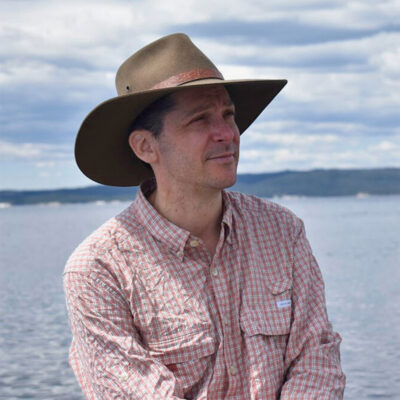
How did your time at Oakwood help shape who you are today, both personally and professionally?
Full disclosure, Oakwood was initially a rough experience. I joined the school in sixth grade when everyone in my class had already been together for years. I came from a religious school where uniforms and moderate regimentation were the norm. Making friends and adapting to the much more liberal Oakwood environment was a real challenge. That challenge subsided somewhat in the seventh grade when roughly half the kids in my year moved on to other schools. Then things got really great a year later when a history teacher named John Leopold strongly encouraged me to join a Dungeons & Dragons club he was creating with a group of kids from outside my grade. I forged friendships for life with some of those students and maintained a close friendship with John until the day he died. It is not an understatement to say that he was instrumental in guiding me to think creatively about the relationship between history and science in a manner that has largely defined my professional career.
When you graduated from Oakwood, did you have a clear sense of what you wanted to pursue academically or professionally?
I didn’t have a clue. All I knew was that I was fascinated by the world and wanted to learn about everything. I’d studied the myths of King Arthur and Merlin with John in an awesome independent study for one term in my senior year, but (incorrectly) believed that there was no way for me to make a career out of analysing how our ancestors’ misunderstandings of the natural world would lead them to believe in nonsense like fire-breathing dragons and wizardry. Little did I realise that I would one day publish books like Science of Monsters and Science of the Magical with Simon & Schuster, which would effectively pay for my house.
Was there a class, activity, or teacher at Oakwood that had a lasting impact on you?
Okay, well, I’ve waxed lyrical about John, so I won’t do more of that. I got on famously with Nancy Meyers/Ranieri and think that the enthusiasm she instilled in me for biology played a key part in leading me to eventually complete my thesis in paleoclimatology at Berkeley. I also loved every minute of my studies with math teacher Pat Komer. While she taught me plenty about algebra and geometry that I’m sure I’ve now forgotten, she taught me something much more important. She taught me how to learn. She insisted that we all buy these little notebooks called stenos from her at the beginning of each term. We were told to keep meticulous notes in those stenos and then build practice questions from them before exams. To this day, even with all the AI support available, I don’t run an interview with a scientist without a steno in my hand.
This all happened because I walked out of Oakwood insatiably curious. That curiosity led me to study both the sciences and the arts.
Can you share a brief overview of your career path and what ultimately inspired you to write your latest book, I Told You So! Scientists Who Were Ridiculed, Exiled, and Imprisoned for Being Right.
I’ve been a science correspondent for The Economist in London for over two decades and have recently started supporting the United Nations Environment Programme with their speech writing for big international conferences (you know, the sorts where we try to convince countries to take biodiversity and global warming seriously – yes, I’m looking at you, America). This all happened because I walked out of Oakwood insatiably curious. That curiosity led me to study both the sciences and the arts. I was terribly torn because, for years, I understood that I had to pick between one of the two. Then I discovered science journalism. Years of interviewing scientists and writing about their research yielded extraordinary insights into what works well and what definitely does not. I’ve seen junior researchers be eviscerated for thinking differently from their supervisors (even though they were right), and then, in the midst of the pandemic, I had a researcher who was sharing her novel view of how COVID-19 was functioning tell me, “You mustn’t report this.” When I asked why, she said, “Because this is immunology, Matt, and I’m a woman.” That struck me as insane, and yet, I’d seen it so often before. It led me to delve into history and ask, “For just how long have we been this dysfunctional in science, and what can we possibly do about it?” That is where this book comes from.
Your newest book explores scientists who were ridiculed, exiled, or even imprisoned for being right. What patterns did you notice across history, and what lessons should we be applying today?
The most important lesson is that we need to keep debate respectful in the realm of research. Scientists are supposed to disagree. Argument is essential; character assassination is not.
What do you love most about being a science correspondent today?
Precisely what led me to this field in the first place: the constant discovery. I get to be curious for a living. I love immersing myself in the latest papers, asking questions, and then writing up my articles for our 2.2 million global readers.
What advice would you give Oakwood students interested in science, journalism, or combining the two?
Stay curious. Explore everything. Remain adaptable.